High-Chrome Wet Ends
27% Cr white-iron impellers and liners sized for abrasive mill discharge, not soft-water transfer.
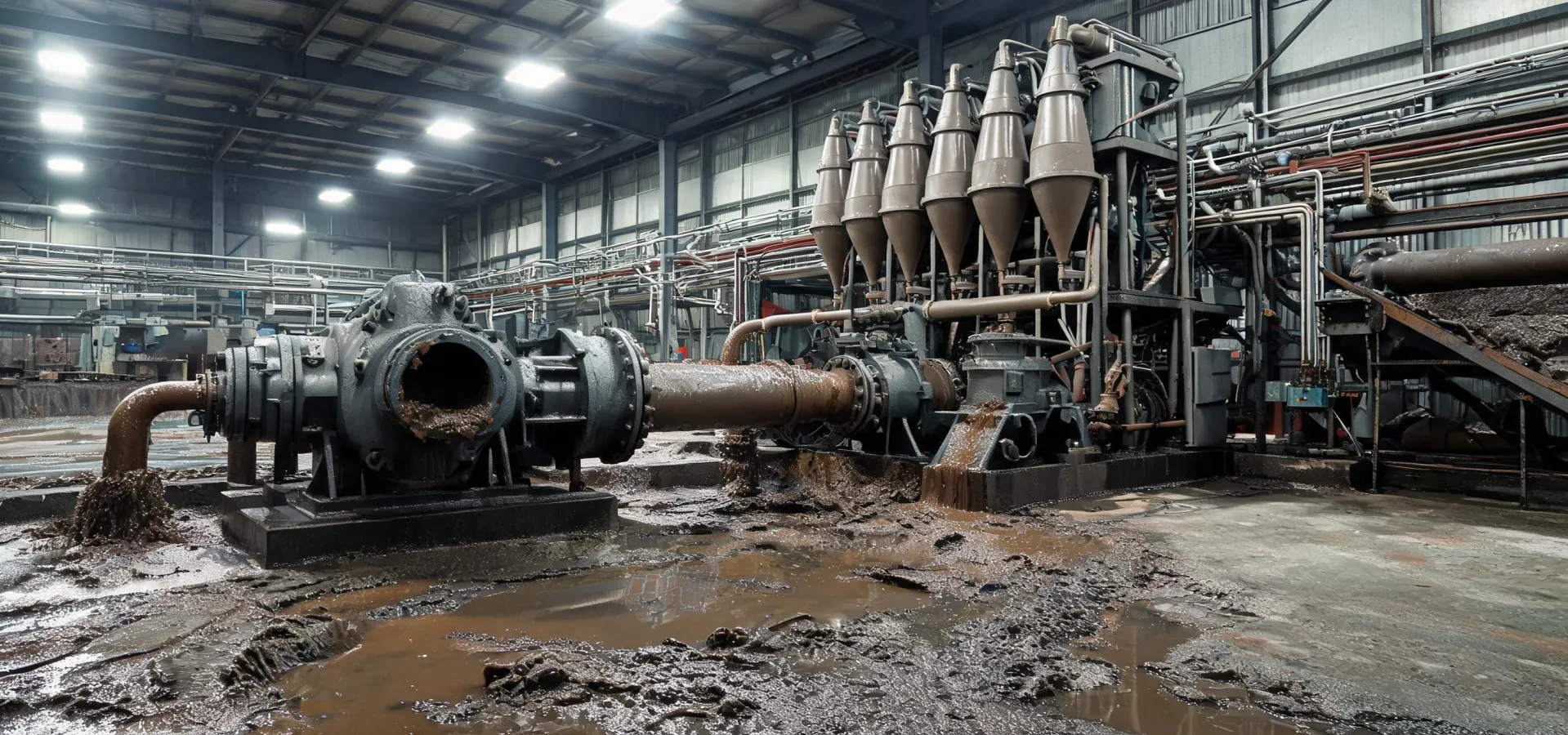
High-chrome wet ends, ISO 4406 hydraulic cleanliness and cut-size curves tuned for SG 1.4–2.2 slurries — sized against feed size, discharge opening and target output capacity (t/h), backed by 18 mine-belt parts hubs.
Baseline configuration for a 65% solids copper mill-discharge duty. Values shift with ore SG, particle size and head — request a site-matched curve before purchase.
| Hydraulics & Duty | |
|---|---|
| Flow range | 180 – 1,200 m³/h (site-tuned impeller trim) |
| Total dynamic head | 18 – 45 m slurry head |
| Solids concentration | Up to 70% by weight · SG 1.4–2.2 |
| Wet End & Materials | |
| Impeller / volute | High-chrome white iron 27% Cr · optional rubber-lined |
| Seal arrangement | Expeller + gland or dual mechanical seal |
| Wear monitoring | Shell thickness ports + vibration probe pad |
| Drive & Documentation | |
| Motor class | IE3 / IE4 · VFD-ready baseplate |
| Cleanliness | Bearing oil ISO 4406 18/16/13 at factory flush |
| Deliverables | Duty curve PDF · NPSHr sheet · wear-part BOM |
27% Cr white-iron impellers and liners sized for abrasive mill discharge, not soft-water transfer.
Every pump ships at 18/16/13 oil cleanliness with a logged factory flush sample.
Hydrocyclone packs sized to D50 targets for flotation feed and mill circulating load.
OEM-equivalent liners, throatbush and impeller kits staged before unplanned downtime hits.
Certified field service engineers, mean-time-to-repair under 16 hours on contracted plants.
Guarding, lockout points and AS 4024-aligned documentation for mill-floor audits.
Background: a 45 kt/d copper concentrator saw mill-discharge pumps drift outside the 85–105% BEP window after ore SG climbed to 2.0 and feed size into the secondary crusher tightened. Process: WeirFlow Mining re-trimmed impellers, reset gland hydraulic system pressure, and staged high-chrome liners ahead of the next planned stop while hydrocyclone apexes were audited for flotation D50. Result: mean-time-to-repair stayed under 16 hours, cut size held within ±5 µm for six months, and output capacity through the classification cluster recovered to the plant’s 2.1 Mt slurry quarterly baseline — without changing the motor frames.
Limitation: tramp-metal events and sump redesigns sit outside this wear model; sites that cannot meet NPSH drawings should request a site-matched recalculation before freezing impeller diameter.
We match BEP to the site head curve at operating SG, then trim impeller diameter so the pump runs 85–105% of BEP at normal circulating load. NPSHr is verified against sump geometry before the order is released.
Rubber wins on finer, less angular particles and lower impact energy; high-chrome is preferred for coarse mill discharge and crusher underflow where gouging abrasion dominates.
On abrasive copper or gold circuits, apex and vortex-finder wear checks every 250–400 operating hours keep cut size within ±5 µm of the flotation feed target.
Usually no. Mill classification and flotation feed need different D50 targets; we size separate packs or provide change-out apex kits with documented cut-size curves.
At 180–220 t/h hard granite, expect 600–900 hours per jaw set depending on CSS, jaw opening and feed size; we trend tonnage-per-millimeter wear and vibration frequency on the screen deck rather than calendar time alone.
Jaw crushers stay the safer primary choice when feed size and ore hardness swing widely (Mohs ≤9) and maintenance crews want a simple discharge opening CSS adjust. Impact crushers win when asphalt or concrete aggregate needs a higher cubicity product and the plant can accept higher wear-part cost for that shape. WeirFlow Mining documents both paths with expected output capacity (t/h) so the bid package records the trade-off instead of a slogan.
Kits are dimensioned to published OEM interfaces for common mill-discharge frames. We confirm bolt circle, shaft sleeve and seal housing before shipping a first article.
18 mine-belt parts hubs · < 16h MTTR · cut-size and wear-rate engineering on call.